Morton's Neuroma
Treatment of burning forefoot pain from thickening of an interdigital nerve
Overview
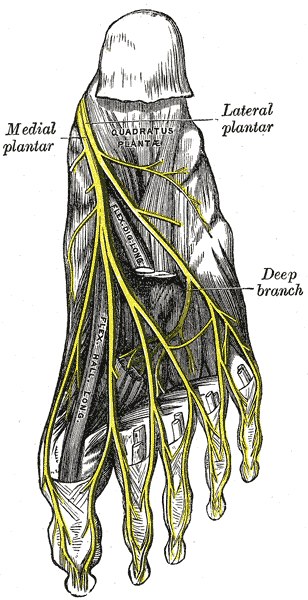
Morton's neuroma is a painful thickening of a digital nerve in the ball of the foot, most often between the third and fourth toes. Despite its name it is not a tumour but thickening of the tissue around a nerve subjected to repeated pressure and friction. Patients describe burning pain in the forefoot, electric shocks radiating into the toes and the sensation of a pebble or a folded sock underfoot. It is considerably more common in women and in those who wear narrow, high-heeled shoes.
Anatomy and Mechanism
The sensory nerves to the toes pass between the metatarsal bones to reach the web spaces, running just beneath the transverse metatarsal ligament that binds the metatarsal heads together.
The nerve between the third and fourth toes is thicker because two nerve branches join there, and the mobility of the adjacent metatarsals differs. Compression is therefore commonest at this site, with the second web space next.
During push-off the metatarsal heads approach one another and the nerve is compressed under the ligament. Repeated compression produces fibrosis around the nerve and degeneration within it.
Narrow, high-heeled shoes accelerate the process directly by increasing forefoot load and squeezing the metatarsal heads together.
Risk Factors
- Narrow, high-heeled footwear: the most important modifiable factor
- Female sex and the 40 - 60 age range
- Running, dancing and prolonged walking
- Foot shape: flat foot, high arch, hallux valgus, hammer toe
- A long second metatarsal and other variations that alter forefoot loading
- Excess weight
- Inflammatory arthritis affecting the forefoot joints
Symptoms
- Burning, throbbing pain in the ball of the foot, most often in the third web space
- Electric shocks, numbness and tingling radiating into the toes
- The sensation of a pebble underfoot or a folded sock
- Pain that builds in shoes and eases on removing the shoe and rubbing the foot: the most characteristic description
- Worse with walking and standing, better with rest
- Marked worsening in narrow, high-heeled shoes
- Splaying of the affected toes in advanced cases
- Swelling and redness are typically absent, and suggest another diagnosis when present
Making the Diagnosis
The diagnosis is primarily clinical. The site of pain, its relation to footwear and the radiating electric sensation are highly indicative.
Pressing in the web space reproduces the pain and tingling. A click felt and heard when the forefoot is squeezed from the sides while the web space is pressed (Mulder's sign) strongly supports the diagnosis. Foot shape, callus pattern and shoe wear are assessed together.
Radiographs do not show the neuroma and are taken to exclude stress fracture, arthritis and other bony causes. Ultrasound is the first-line imaging study: it shows the thickened nerve dynamically, is inexpensive and guides injection. MRI is used in doubtful cases and for surgical planning, particularly when more than one web space may be involved.
The differential diagnosis includes metatarsal stress fracture, metatarsophalangeal joint instability and synovitis, Freiberg's disease, tarsal tunnel syndrome and lumbar radiculopathy.
Non-operative Treatment
Treatment always begins non-operatively, and a substantial proportion of patients improve markedly with footwear change and orthotics. No treatment gives a lasting result unless the footwear is addressed.
- Footwear change: wide toe box, heel under three centimetres, soft sole. This is the foundation of treatment
- Metatarsal pad placed just behind the metatarsal heads to separate them and unload the nerve
- Custom orthotics to redistribute forefoot load and correct flat foot or high arch
- Activity modification: a break from running and long walks, less forefoot loading sport
- Anti-inflammatory medication and ice
- Ultrasound-guided corticosteroid injection gives months of relief in a substantial proportion of patients. Repeated injections are avoided — they can cause fat pad atrophy, skin depigmentation and weakening of the surrounding ligaments
- Alcohol ablation and radiofrequency treatment are used in selected cases with variable results
- Calf and Achilles stretching, since tight posterior calf muscles increase forefoot load
- Response is assessed after 3 - 6 months of consistent treatment
Surgery & First 3 Weeks
Surgery is considered when symptoms persist despite well-conducted non-operative treatment. There are two approaches: dividing the ligament that compresses the nerve while preserving it, or excising the thickened segment of nerve.
Indications for Surgery
- Pain persisting despite at least 3 - 6 months of footwear change, orthotics and injection
- Pain that limits daily life and walking distance
- A diagnosis clearly confirmed by examination and imaging
- A response to injection, even temporary, which predicts surgical success
- Patients whose footwear habits do not change must be told that symptoms may recur after surgery
Nerve-preserving Surgery (Ligament Release)
The transverse metatarsal ligament binding the metatarsal heads is divided to relieve pressure, and the nerve itself is preserved.
Its major advantage is that no permanent numbness results in the web space. It suits early disease with limited nerve thickening, and may be insufficient where thickening is advanced.
Neuroma Excision
The thickened segment of nerve is identified and removed. A dorsal incision is generally preferred, as it allows earlier heel weight-bearing and avoids a painful scar on the sole. A plantar incision, which gives direct exposure, is used particularly in revision cases.
Because the nerve is removed, permanent numbness in the web space follows. This is not a complication but a known and accepted consequence, and must be explained before surgery.
Burying the cut nerve end within muscle is a technique used to reduce the risk of a stump neuroma.
The Operation
- Performed as a day case under ankle block or general anaesthesia
- Operating time is 20 - 45 minutes
- A stiff-soled postoperative shoe allows heel weight-bearing afterwards
- Weight-bearing starts earlier after a dorsal incision and later after a plantar one
- Sutures are removed at 12 - 16 days
Risks & Complications
Surgery relieves pain in the great majority of patients, but has problems particular to forefoot surgery that should be understood beforehand — above all that numbness in the web space is permanent once the nerve is removed.
General Surgical Risks
- Wound infection
- Bleeding and haematoma
- Risks related to anaesthesia
- Wound healing problems: the skin on the dorsum of the foot is thin and needs care
- Deep vein thrombosis: rare, with risk rising if immobility is prolonged
Risks Specific to This Operation
- Permanent numbness between the toes: an expected consequence of removing the nerve, not a complication
- Stump neuroma: a new, painful thickening at the cut nerve end and a leading reason for revision surgery
- Painful scar and callus after a plantar incision, reduced by using a dorsal approach
- Transfer metatarsalgia: new pain beneath an adjacent metatarsal as loading changes
- Splaying of the toes after division of the transverse ligament
- Recurrence if footwear habits do not change
- Complex regional pain syndrome: rare
Rehabilitation
Rehabilitation protects wound healing while forefoot loading is increased gradually, swelling is controlled and gait is normalised. Timings differ between dorsal and plantar incisions.
0 - 2 Weeks
- Heel weight-bearing in a stiff-soled postoperative shoe; no load on the forefoot
- Elevation and ice to control swelling
- The dressing is kept clean and dry and the foot is not soaked
- Gentle toe movement; prolonged immobility is avoided
- Long walks, running and prolonged standing are forbidden
2 - 6 Weeks
- Scar massage and moisturising after suture removal
- Forefoot loading increased gradually, moving from the postoperative shoe to a wide, soft trainer
- Toe and ankle range of motion work, calf stretching
- Return to desk work at 1 - 2 weeks and to standing work at 4 - 6 weeks
- Metatarsal pads or orthotics are reintroduced
6 - 12 Weeks
- Normal gait restored and walking distance increased progressively
- Strengthening of the calf and intrinsic foot muscles, balance work
- Return to low-impact sport: cycling and swimming usually at 6 - 8 weeks
- Return to running and jumping sports usually at 10 - 12 weeks
- Forefoot swelling may last several months and is expected to be worse in the evening
The Long Term and Preventing Recurrence
- Permanently adopting wide, low-heeled footwear is the most effective way to prevent recurrence
- Long-term use of orthotics and metatarsal pads
- Patients are reminded that web space numbness is permanent but rarely affects daily life
- Pain returning months later suggests a stump neuroma and requires reassessment
- Weight control and calf flexibility reduce forefoot load
Is This Treatment Right for You?
Every patient's condition is different. After a detailed examination and imaging, the treatment plan that suits you best will be prepared.
Would you like more information about Morton's Neuroma?
Book Appointment